Manifesto on Slow Thinking
Introduction
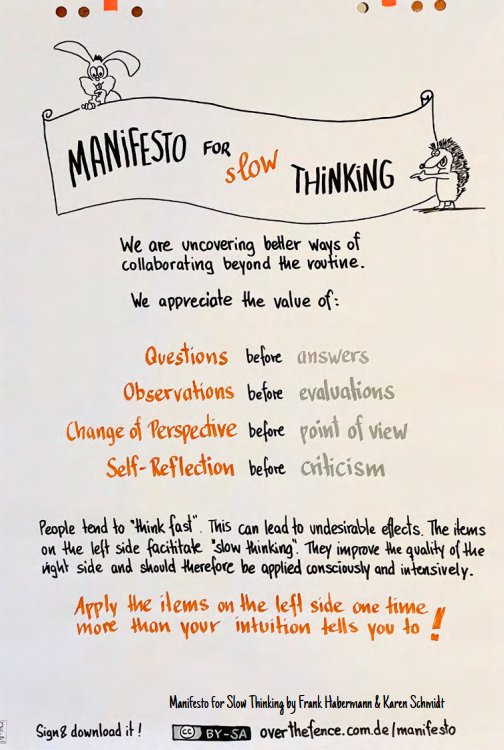
The manifesto for slow thinking emphasizes the importance of slowing down and thinking more deliberately to achieve better outcomes. It challenges the default “fast thinking” mode, which can lead to undesirable effects, advocating instead for a more intentional and slow approach to improve decision-making and collaboration.
Key Principles
- Importance of Asking Questions: Before providing answers, prioritize asking questions to gain deeper understanding.
- Observe Before Evaluating: Take time to observe situations fully before forming evaluations or judgments.
- Change Perspectives Before Taking a Stand: Consider different viewpoints before committing to a position.
Benefits
- Improved emotional intelligence
- Better collaboration
- More sustainable success
Applications
The manifesto can be applied in various contexts, including:
- Project management
- Leadership
- Personal development
Supporting Theories
The concept of slow thinking is supported by theories such as Daniel Kahneman’s work on fast and slow thinking, which suggests that people have two systems of thinking: a fast, intuitive system and a slower, more deliberate system.
Alternative
Based on the idea of fast and slow thinking in this video:
Support
If you agree with the above, lend your signature to the fanbase here.
Practice
-
Mindful Questioning: Before jumping to conclusions or making decisions, take a moment to ask yourself probing questions. This helps uncover underlying assumptions and leads to more informed decisions.
-
Observation Practice: Spend time observing situations without immediately reacting. This could be as simple as taking a few deep breaths before responding in a conversation or pausing to reflect on a problem before solving it.
-
Perspective Shifting: Regularly practice seeing situations from different perspectives. This can be done by discussing issues with others who have different viewpoints or by imagining how someone else might perceive the same situation.
-
Scheduled Reflection: Set aside time regularly to reflect on your decisions and actions. Consider what went well, what could be improved, and how slow thinking could have influenced the outcomes.
-
Journaling: Keep a journal to document your thoughts and reflections. This can help you track your progress in adopting slow thinking practices and identify patterns in your thinking.
-
Mindfulness and Meditation: Engage in mindfulness or meditation practices to enhance your ability to slow down and focus your thoughts.
By integrating these practices into your daily routine, you can cultivate a habit of slow thinking that enhances your decision-making and overall well-being.