4 Phases Model
-
-
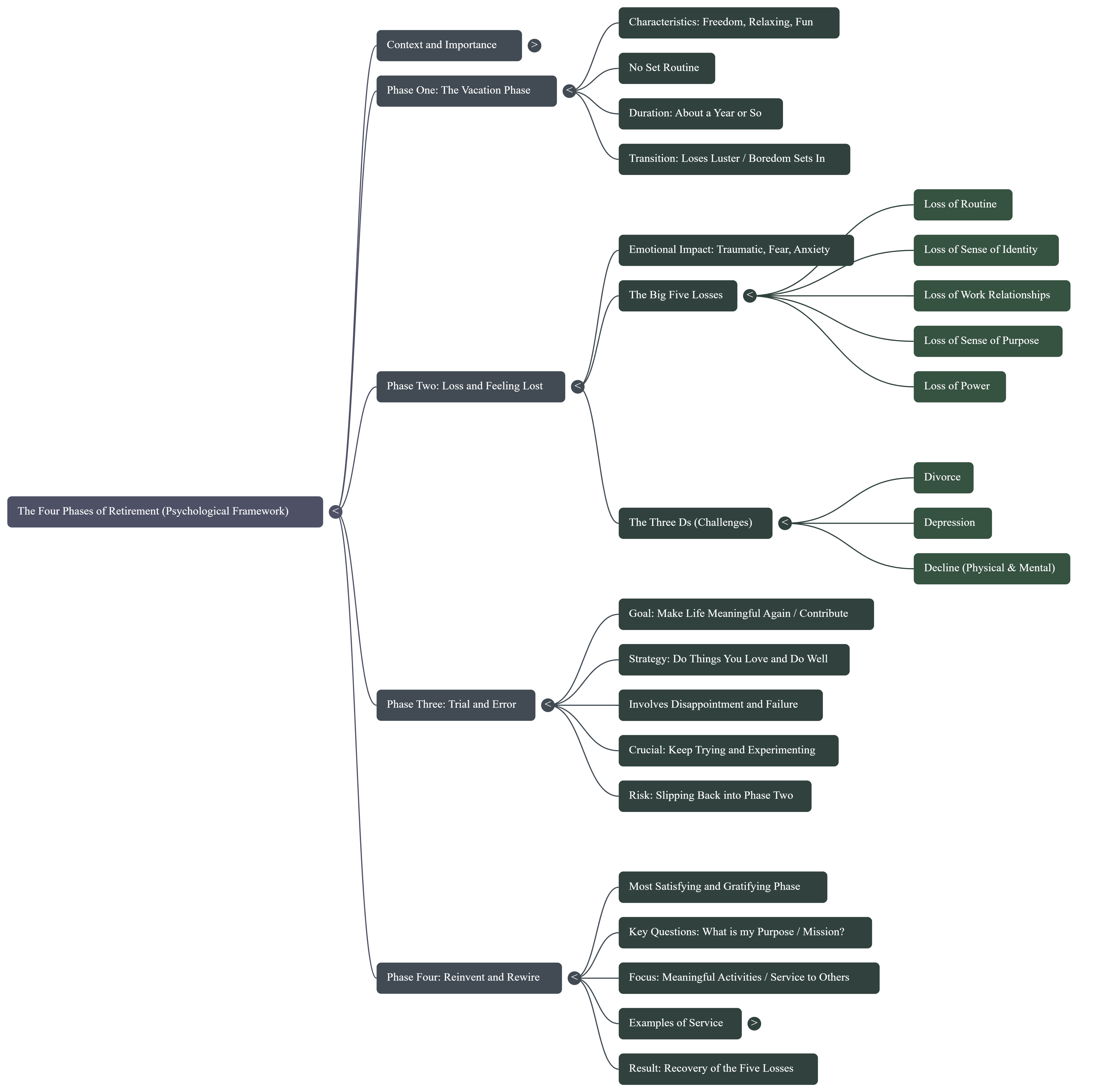
The video outlines four distinct phases that most retirees move through, emphasizing that retirement requires psychological preparation in addition to financial readiness [1-4].
-
Successfully navigating these phases allows one to “squeeze all the juice out of retirement” in the final stage.
Here is an outline of the four phases:
-
Phase One: The Vacation Phase
collapsed:: true
- Characteristics: This phase is characterized by freedom, allowing you to wake up when you want and do what you want all day [4, 7].
- Routine: The best part for most people is that there is no set routine [7].
- Perception: Phase One often represents the common view of an ideal retirement—relaxing, fun in the sun [7].
- Duration and Transition: For most people, Phase One lasts about a year or so, but then it begins to lose its luster [7].
- “Decompressing” or Transitioning from
- Fight and Flight to
- Rear and Restore
- People start to feel bored and actually miss their routine, leading them to ask, “Is that all there is to retirement?” [7]. When these thoughts bubble up, the person has moved into Phase Two [7].
- Characteristics: This phase is characterized by freedom, allowing you to wake up when you want and do what you want all day [4, 7].
-
Phase Two: Loss and Being Lost
- Experience: This is a traumatic phase where individuals feel both loss and being lost [8, 9].
- The “Big Five Losses”: Retirement is associated with five significant losses that often hit all at once:
- Loss of routine [6, 8].
- Loss of a sense of identity [6, 8].
- Loss of many established relationships from work [6, 8].
- Loss of a sense of purpose [6, 8].
- Loss of power (for some people) [6, 8].
- The “Three Ds”: Phase Two is also when people come face to face with divorce, depression, and decline (both physical and mental) [9].
- Impact: The result of all these changes can make a person feel like they have been hit by a bus [9]. Before moving on, people will likely feel fear, anxiety, and even depression [9, 10].
- Transition: Fortunately, most people eventually say they cannot spend the rest of their life feeling like this, which signals a move toward Phase Three [9, 11].
-
Phase Three: Trial and Error
- Objective: In this phase, individuals ask, “How can I make my life meaningful again? How can I contribute?” [11].
- Action: The answer often involves attempting to do things that they love to do and do really well [11]. This phase is focused on keeping trying and experimenting with different activities that will make them want to get up in the morning again [6, 10, 12].
- Challenges: Phase Three can deliver disappointment and failure [11]. Examples include serving on a condo board, exploring law school, completing a dispute resolution program that goes nowhere, or creating a program with “limited success” [11, 12].
- Risk: If a person stops experimenting and trying new activities, there is a chance of slipping back into Phase Two, which is described as “not a happy prospect” [10].
-
Phase Four: Reinvent and Rewire [10]
collapsed:: true
- Satisfaction: This is the most gratifying and satisfying of the four phases, and it is where people can squeeze all the juice out of retirement [4, 6, 10]. Those who break through to this phase are described as some of the happiest people the speaker has met [10].
- Objective: Phase Four involves “reinventing and rewiring” and answering tough questions like, “What’s the purpose here? What’s my mission?” [10].
- Key Activities: It is important to find activities that are meaningful and provide a sense of accomplishment and his (()) . In the speaker’s experience, this usually involves service to others Maslow’s hierarchy of needs ((6926ac8d-f3b4-498e-9e6c-ce8c9843364c)) or ((6926b24c-6e15-4467-b7c5-10b92e8b9d7c))
- See below but examples include helping a charity, giving advice based on years of experience, or teaching skills to others in a community group (like teaching members of a 55+ group how to use iPhones and iPads)
-
- Recovery: Crucially, in Phase Four, the “Big Five Losses” experienced in Phase Two—the loss of routine, identity, relationships, purpose, and power—are all recovered. This outcome is described as “magic” [6, 16].
-
Levelling Up in the Game
-
The sources describe Phase Four as the stage of retirement focused on reinvent and rewire, which is noted as the most gratifying and satisfying of the four phases. Successfully navigating this phase involves answering tough questions like “What’s the purpose here?” and “What’s my mission?“.
The key to squeezing “all the juice out of retirement” in Phase Four is finding activities that are meaningful and provide a sense of accomplishment. According to the sources, this successful fulfillment almost always involves service to others.
The Context of Service in Phase Four
In the context of Phase Four, engaging in service is crucial because it leads to the recovery of the “big five” losses experienced in Phase Two. These losses include a sense of routine, identity, relationships, purpose, and power. By engaging in service, retirees can recover all these lost elements, which is described as “magic to see”.
-
Examples of Service Activities
The sources provide several detailed examples of how retirees engaged in meaningful service during Phase Four:
-
1. General Charity Work Service can take the form of simply helping a charity that you care about.
-
2. Sharing Life Experience and Expertise Another example involves leveraging the vast years of experience retirees possess. This was demonstrated by the “old coots” who set up a booth at a local farmers market to give advice to anyone who stopped by. Although they were tested when a visitor needed help with math homework on a tablet, they did their best.
-
3. Developing Community Education Programs (Bill’s Initiative) collapsed:: true A significant example of service comes from the initiative of the speaker’s friend, Bill, who belonged to a “55 plus activity group”. Bill recognized the tremendous pool of expertise and experience within the group and sought volunteers to teach others things they loved to do.
- Specific examples of teaching and mentoring service activities include:
collapsed:: true
-
Technology Education: Bill personally taught two sessions on iPads and iPhones, recognizing that many members had received these devices as gifts but barely knew how to operate them.
-
Life Skills and Hobbies: Members volunteered to teach various skills and pastimes, such as how to play bridge and mahjong, how to paint, and how to repair bicycles.
-
Community Support and Mentoring: Members extended their service outward by tutoring and mentoring local school kids. They also set up English-as-a-second-language (ESL) programs for newcomers.
Bill’s initiative quickly grew, demonstrating the appeal and success of this type of service engagement. The first year, nine programs were offered with 200 participants; the next year, this expanded to 45 programs with over 700 participants; and the following year, they offered over 90 programs with 2,100 registrations.
-
- Specific examples of teaching and mentoring service activities include:
collapsed:: true
-
4. Social and Enrichment Clubs Beyond direct instructional service, the sources mention other enriching, community-focused activities in Phase Four, such as book clubs, film clubs, and even golf clubs. These activities, which are described as both “exhausting but exhilarating,” demonstrate what is possible when one successfully reinvents and rewires their retirement life.
- The activities undertaken in Phase Four are ultimately focused on contribution, allowing the retiree to find a life that is meaningful again.
}}
- Context of Time
- If retiring at 65 and living until 85, you have about 1,000 weeks left.
- Reality Check: You may only have about 500 weeks of true health and energy (the “go-go years”).
- 75-85 >>> “slow-go”
- 85+ >>>> “no-go”
- Lessons are derived from people 10 to 20 years older who have lived through the successes and regrets of retirement.
- Money and Financial Lessons
- Lesson 1: Money as Time Freedom
collapsed:: true
- Money is the ability to spend time how you choose, not how circumstances force you to.
- Application: Don’t hoard money if it means missing experiences during your healthy years.
- The goal is to live fully while you can, not to die with the most money. Memories lost can never be bought back.
- Lesson 2: Rent Objects, Buy Experiences
collapsed:: true
- Objects depreciate in value and satisfaction.
- Experiences appreciate in memory and become more meaningful over time.
- Application: Choose experiences (like a European family vacation) over things (like a new luxury car).
- Lesson 3: The Deathbed Test
collapsed:: true
- Question: At 90 or 95, will you care more about an extra $50,000 saved or the experiences you had?
- Application: Stop oversaving if it means missing meaningful experiences during your healthy years.
- Lesson 1: Money as Time Freedom
collapsed:: true
- Energy and Time Management
- Lesson 4: Energy Management Over Time Management
collapsed:: true
- You can have all the time in the world, but if you’re running on empty, you can’t do meaningful activities.
- Application: Audit what gives you energy versus what drains it. Design your retirement around energy giving activities and relationships. Minimize energy draining activities or people where possible.
- Lesson 5: The 90 Second Rule
collapsed:: true
- Emotions last about 90 seconds in the body; staying in that emotional state afterward is a choice based on continuing the thoughts that triggered it.
- Application: Don’t let frustration (about aging, health, or news) control your days. Acknowledge feelings and let them run their course, then choose your response (e.g., focus on gratitude).
- Lesson 6: Combat Time Acceleration
collapsed:: true
- Time feels shorter as we age because we have fewer new experiences and routines blur together.
- Application: Constantly learn new things or have new experiences to make time feel richer and more memorable. Schedule at least one genuinely new experience each month (e.g., cooking class, cultural event, visiting a museum you haven’t seen). Watching a different TV show does not count.
- Lesson 7: Compound Living
collapsed:: true
- Small, daily investments in relationships and experiences multiply over time, similar to compound interest.
- Application: Daily calls to family/friends, weekly coffee dates, or monthly new adventures compound into a rich, connected retirement.
- Lesson 4: Energy Management Over Time Management
collapsed:: true
- Relationship-Focused Lessons
- Lesson 8: The Relationship Bank Account
collapsed:: true
- Every interaction is either a deposit (appreciation, support, genuine interest) or a withdrawal (complaints, criticism, taking without giving).
- Application: Invest in making deposits. Become aware of which relationships fill you up and which drain you.
- Lesson 9: Shared Challenges
collapsed:: true
- Research shows that going through challenges together builds stronger bonds than just having fun.
- Application: Volunteer together with your spouse or friends, or take on meaningful projects as a group.
- Lesson 10: Weak Ties Matter
collapsed:: true
- Don’t underestimate casual acquaintances (neighbors, regular contacts); they can open doors to new opportunities and perspectives.
- Application: Join clubs, take classes, or attend community events to stay connected to the broader world.
- Lesson 8: The Relationship Bank Account
collapsed:: true
- Growth and Learning
- Lesson 11: Step Outside of Your Comfort Zone
collapsed:: true
- Your best opportunities in retirement may lie outside your comfort zone.
- Application: Explore adjacent interests that build on your lifetime of experiences (e.g., a former accountant teaching financial literacy).
- Lesson 12: Optimize for Learning and Not Just Comfort
collapsed:: true
- Comfort is the enemy of growth.
- Application: Your 60s and 70s are perfect for learning because you have the time, resources, and life experiences to provide context. Learning new skills keeps your mind sharp.
- Lesson 11: Step Outside of Your Comfort Zone
collapsed:: true
- Creativity and Health
- Lesson 13: Strategic Incompetence (Creativity related)
collapsed:: true
- Stay deliberately amateur at some things to maintain the joy of learning.
- Application: Maintain a beginner’s mind; don’t worry about failing or looking stupid. The joy is often in the process, not in mastering everything.
- Lesson 14: Creativity as a Faucet
collapsed:: true
- Creativity is like a faucet or a muscle: it flows easily when turned on regularly, but the pipes can get rusty if left off too long.
- Application: Start that art class, write the book, or learn that new instrument. Push through the beginner’s phase where creations feel inadequate. The goal is to engage the creative part of your brain and soul.
- Lesson 15: Health as a Life Force Multiplier
collapsed:: true
- Every aspect of retirement (money, relationships, hobbies, travel) improves or suffers based on physical and mental health.
- Application: Prioritize health over everything else. The retiree who exercises, eats well, and manages stress will have a fundamentally different experience.
- Lesson 16: Knowing the Difference Between Morning You and Evening You
collapsed:: true
- You have different energy levels throughout the day (e.g., peak energy in the morning or middle of the afternoon).
- Application: Schedule important activities to line up with your peak energy levels. Save low-energy tasks (watching TV, light reading) for off-peak hours.
- Lesson 13: Strategic Incompetence (Creativity related)
collapsed:: true
- Documentation and Mental Models
- Lesson 17: Document Your Journey
collapsed:: true
- Documentation helps brains see progress, which prevents motivation from waning.
- Application: Keep a retirement journal, maintain photo albums, or start a blog to share experiences and thoughts. At a minimum, write down three wins from the day.
- Mental Model 1: Second Order Thinking
collapsed:: true
- Think two or three steps down the line (“what happens after what happens next”).
- Application: When making big decisions (e.g., moving to a warmer retirement community), think about what your relationship network will look like in five years.
- Mental Model 2: Inverse Thinking
collapsed:: true
- Instead of asking how to solve a problem, ask how you are creating it or what would guarantee that the problem gets worse.
- Application: If you are unhappy, instead of asking “How do I become happier?”, ask “What am I doing (or not doing) right now that is creating this dissatisfaction?“.
- Lesson 17: Document Your Journey
collapsed:: true
- Retirement Design Lessons
- Lesson 18: Test and Don’t Just Plan
collapsed:: true
- You cannot think your way into the right retirement; you must test your way there. Plans are hypotheses that must be tested against reality.
- Application: Try a mini-retirement before fully retiring, volunteer in an interesting area before committing, or rent for an extended time in a potential new location before buying.
- Lesson 19: Design Your Own Metrics
collapsed:: true
- Do not measure retirement success by society’s standards or neighbors’ choices.
- Application: Define success for yourself, which might mean deep relationships, learning new skills, contributing to causes, spiritual growth, or simply peace and contentment.
- Lesson 20: Regular Life Reviews
collapsed:: true
- Monthly reviews prevent yearly regrets; regular course corrections prevent major life mistakes.
- Application: Schedule quarterly or monthly retirement reviews to assess what is working, what needs adjustment, what brought joy, and what drained your energy. Small adjustments compound into major life improvements.
- Lesson 18: Test and Don’t Just Plan
collapsed:: true