Doughnut Economics
Intro

-
Interactive Doughnut for the visual model
-
Introduction and Summary of 7 Ways of New Thinking
Expand
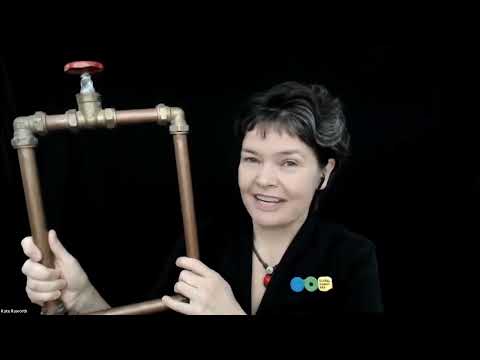
In the video, Kate Raworth outlines seven fundamental shifts in economic thinking to meet the challenges of the 21st century:
1. Change the Goal [01:03]
- Move away from the 20th-century obsession with endless GDP growth, which Raworth describes as “insane and ultimately impossible” [02:04].
- Replace it with the goal of “thriving in balance” within the Doughnut: ensuring no one falls short on life’s essentials (social foundation) while not overshooting the planet’s ecological ceiling [02:12].
2. See the Big Picture [04:22]
- Move beyond the “circular flow” model that focuses only on money and goods, which ignores energy and nature [04:36].
- Adopt the Embedded Economy model: recognizing the economy is a social construct embedded in society, which is itself embedded in the living world and dependent on solar energy [05:25].
- Acknowledge four ways of provisioning: the market, the state, the household (unpaid care), and the commons (community collaboration) [06:42].
3. Nurture Human Nature [08:10]
- Reject the “Rational Economic Man” model—the self-interested, isolated individual with a calculator for a brain [08:34].
- Replace it with a portrait of humanity as social, interdependent mammals who are capable of empathy, reciprocity, and collaboration [09:47].
4. Get Savvy with Systems [10:19]
- Stop treating the economy as a predictable, mechanistic machine that can be controlled by a “mechanic” [10:25].
- View it as a complex adaptive system with feedback loops and tipping points, requiring economists to act more like “gardeners” who steward and shape the system’s dynamics [10:55].
5. Design to Distribute [11:23]
- Challenge the “divisive by design” economies that concentrate wealth in the hands of a few [11:29].
- Create economies that are distributive by design, ensuring value and opportunity are shared with everyone who helps co-create them [12:19].
6. Create to Regenerate [12:44]
- Transition from a “degenerative” linear economy (take-make-use-lose) that destroys the living world [12:53].
- Move toward a regenerative, circular economy where resources are used more slowly and cycled back into the system [13:15].
7. Be Agnostic about Growth [15:30]
- Confront the structural dependency and addiction to endless growth [15:46].
- Recognize that while growth is a healthy phase, nothing in nature grows forever without destroying itself [16:10].
- Aim for economies that “grow up and mature,” learning to thrive whether or not they are growing in GDP [16:34].
Raworth also suggests an 8th way: Practice, which involves learning by doing and testing these theories in real-world communities and businesses [17:21].
Strengths and Weaknesses
Since Kate Raworth introduced Doughnut Economics in 2012 (and later in her 2017 book), or 14 years ago, it has been widely praised for its visionary approach while also facing significant scrutiny regarding its practical application.
Strengths
Shift in Economic Purpose
- It provides a powerful critique of “GDP-fetishism,” arguing that we should focus on thriving rather than growing. - also see Gross National Happiness and Degrowth - Better Growth
- It reintroduces the importance of the “household” (unpaid care work) and the “commons,” which are often ignored in mainstream circular flow diagrams.
Holistic Integration of Social and Ecological Goals
- Unlike traditional models that treat environmental issues as “externalities,” the Doughnut places them at the core of economic success.
- It successfully synthesizes 12 social foundations (based on the UN Sustainable Development Goals) with 9 planetary boundaries.
Accessible Visualization & Communication
- The “Doughnut” is frequently cited as a brilliant communication tool that makes complex systems thinking and sustainable development goals intuitive for non-experts.
- It moves economic discourse away from abstract equations and toward a visual “compass” that people can easily grasp.
Practical Adaptability at Local Levels
- Cities like Amsterdam, Copenhagen, and Brussels have successfully used the framework to guide urban policy, demonstrating its utility as a strategic roadmap for local governments.
Weaknesses
Reliance on “Miracles” or Persuasion
- Critics argue Raworth is overly optimistic about the power of “changing the story” to overcome entrenched neoliberal mindsets and the raw power of vested financial interests.
-
Change starts with Education > the story we tell our children in school about economics is a start perhaps… good to see this is being addressed see YT video
Oversimplification of Trade-offs
- Academic reviewers have noted that the model often assumes we can meet all social needs without hitting ecological limits, without fully addressing the hard trade-offs (e.g., the energy required to provide universal healthcare vs. carbon budgets).
-
Does the model suggest we may need to compromise on social needs into order to stay within ecological limits? So for example, some studies have suggested the planet is overpopulated. If so, do we need to regulate child birth e.g. China’s one boy policy?
The “Growth Dilemma” & Real-World Feasibility
- Some economists (like Branko Milanović) point out that to bring the billions currently in the “hole” of the doughnut up to a decent standard of living, global GDP might actually need to increase significantly, contradicting the “growth-agnostic” stance.
- Critics question whether a “no-growth” regime is politically stable or if it would cause democratic institutions to collapse under distributional conflict.
-
Surely the word agnostic is what it is - neutral on GDP upwards, downwards or the same. The focus needs to be on other metric(s) e.g. Social Progress Index
Western-Centric Perspective
- Some scholars argue the model reflects a predominantly Western/Global North worldview. Developing nations may find the “ecological ceiling” restrictive when they are still trying to build basic infrastructure and pull millions out of poverty.
-
Surely the ceiling is non negotiable and something as citizens of the world we need to all abide by? Perhaps the idea of Doughnut Economics needs to be considered against the idea of Nation State and Nation State Culture
Lack of Specific Policy Prescriptions
- Critics, including some welfare economists, argue that while the model identifies where we want to go, it offers little detail on how to get there. It lacks a concrete “manual” for tax reform, trade policy, or financial regulation.
Summary of the “Eighth Way”
Kate Raworth herself has acknowledged some of these gaps by co-founding the Doughnut Economics Action Lab (DEAL) to address the “missing manual” and turn the theory into practice through real-world experimentation.
Analysis
1. Reorientation Based on Constraints and Rights
Expand
Your assessment that she is “reorienting” the economy around environmental constraints and human rights is the core of the theory.
The Ecological Ceiling (The Outer Ring): This represents the planetary boundaries (such as climate change, biodiversity loss, and ocean acidification). The goal is to ensure economic activity does not “overshoot” these limits, which would destabilize the Earth’s life-support systems.
The Social Foundation (The Inner Ring): This is derived directly from the UN Sustainable Development Goals (SDGs). It includes 12 essentials like food, water, health, education, and political voice. Raworth argues that no person should fall into the “hole” of the doughnut—meaning their fundamental human rights must be met.
The Safe and Just Space: The “doughnut” itself is the space between these two rings where humanity can thrive. It is an economy designed to be distributive (sharing value) and regenerative (working with nature rather than against it).
2. The Question of “Growth”
Expand
The relationship between this new structure and growth is a point of frequent debate. Raworth describes her stance as being “growth agnostic.”
Not the Main Purpose: You are correct that growth is not the goal. In the current system, we have an economy that needs to grow, whether or not it makes us thrive. Raworth wants an economy that makes us thrive, whether or not it grows.
Could it lead to growth?
- In Developing Nations: Raworth explicitly states that significant GDP growth is necessary for low- and middle-income countries to reach the “social foundation” (building schools, hospitals, and clean energy grids).
- In Developed Nations (like the UK): The focus shifts toward “thriving in balance.” While traditional GDP might slow down or fluctuate, there would be massive growth in specific sectors: renewable energy, circular manufacturing, repair economies, and social care.
3. Relation to Economic Multipliers
1. The “Green Multiplier” Effect (IMF & World Bank)
Recent studies indicate that investments aligned with the “Ecological Ceiling” of the Doughnut (renewables, biodiversity, and circular systems) often have higher economic multipliers than traditional fossil fuel or extractive investments.
- IMF Analysis (2021/2025): Research into “Green Spending Multipliers” found that for every £1 ($1) spent on carbon-neutral or carbon-sink activities (like renewable energy or ecosystem restoration), the output multiplier is typically 1.1 to 1.5.
- Comparison: In contrast, traditional non-eco-friendly energy investments often show multipliers as low as 0.5 to 0.6. This suggests that “green” investments are more effective at stimulating broader economic activity because they are more labor-intensive and rely on local supply chains.
- Engineering Relevance: This higher multiplier is driven by the need for specialized technical labor—exactly where your son’s environmental engineering background fits.
2. Analysis of the New Zealand “Wellbeing Budget”
Peer-reviewed reviews of New Zealand’s transition (2019–2025) provide a nuanced view of “Wellbeing” as an investment strategy:
- The Multiplier of “Human Capital”: The NZ Treasury and independent researchers have analyzed the “Living Standards Framework.” They found that treating social spending (mental health, child poverty) as an investment rather than a cost leads to long-term productivity gains.
- Critique of Short-termism: Some analyses (e.g., in the journal Ecological Economics) argue that while the “multiplier” for social wellbeing is high over a 10–20 year horizon, it can appear lower in the 1–3 year window favored by traditional GDP accounting.
- Systemic Resilience: A key finding is that these investments act as a “buffer” during crises (like the 2020–2022 period), reducing the long-term cost of economic shocks.
3. Regenerative Agriculture and Local Multipliers
Studies in journals like Economic Alternatives (2025) and The GPI Journal have looked at regenerative investments:
- Cost-Benefit Ratio: Peer-reviewed Cost-Benefit Analyses (CBA) of regenerative agricultural practices show a Benefit-Cost Ratio (BCR) above 1.0. This means that every unit of currency invested yields more than its value in combined financial and socio-ecological returns (soil health, water retention, carbon sequestration).
- Local Recirculation: Because these models prioritize “distributive” design (one of Kate Raworth’s key pillars), they tend to keep money circulating within the local economy longer than centralized industrial models.
| Investment Type | Traditional (GDP-Focus) | Doughnut/Wellbeing (Constraint-Focus) |
|---|---|---|
| Energy | Fossil Fuels (Multiplier: ~0.5) | Renewables/Efficiency (Multiplier: 1.1–1.5) |
| Social | ”Welfare Cost” (Seen as a drain) | “Human Capital Investment” (Long-term productivity) |
| Agriculture | High Input/Industrial | Regenerative (BCR > 1.0 + Public Goods) |
| Waste | Linear (Landfill/Export) | Circular (Closed-loop / Chemical Engineering focus) |
DEAL: Practice and Prescriptions
- DEAL YouTube Playlists
- Case Studies:
- New Zealand
- Costa Rica
- UK Green Party
- Amsterdam Circular Economy
Related Concepts
- Degrowth - Better Growth
- Gross National Happiness
- Social Inner Circle: Sustainable Development Goals
- Environmental Outer Circle: climate change